This research study examined the Federal Aviation Administration’s (FAA’s) claim that 80% of all aviation accidents are due to human factors. The aviation accident data was originally obtained from the FAA’s Aviation Safety Reporting System (ASRS) which consisted of several variables, specifically accidents primarily caused by human factors, were analyzed with a time parameter from the years 2015 to 2019. This nominal data was analyzed and manipulated using the StatCrunch program, with the hypothesis that there would be a clear difference between the true proportion of aviation accidents caused by human factors from the years 2015 – 2019 compared to the FAA’s claim that over 80% of aviation accidents are caused by human factors. In addition to this analysis, special attention was placed on aviation accidents primarily caused by human factors from 2015 to 2019 between the 50 states of the United States of America, as well as the types of aircraft operator organization. The study’s findings support of the alternative hypothesis, suggesting that the FAA’s claim that 80% of aviation accidents are attributed to human factors is not a correct statement. In fact, this research concluded that about 35% of aircraft accidents can be attributed to errors in human factors, and that the state of California and Air Carrier operators experience the most aviation accidents related to human factors.
Keywords: Aviation Accidents, Human Factors, FAA, ASRS
Human Factors in Aviation: A Quantitative Study of Aircraft Accidents from 2015-2019
Despite the technical sophistication, adaptation, and advancements that have resided throughout the aviation industry, there is still a high percentage of aircraft accidents that are attributed to human factors. As outlined by the Federal Aviation Administration (FAA), about 80% of all aviation accidents can be attributed to human errors (Winningham, 2020). With the expected growth in air traffic during the next few decades, there is an increasing concern that this rate of aviation accidents that are primarily caused by human factors may skyrocket if it is not addressed.
Although there has been work done to maintain aviation safety, little has been effective at reducing these human-factors occurrences and consequences. Throughout the literature, it has been seen that most studies regarding this issue look mainly at specific factors or links in the overall accident equation, such as maintenance errors or pilot distraction. Because of this narrow focus, there has been little overall improvement in the understanding and mitigation of these underlying human factors errors in aviation. Since plane crashes are becoming deadlier over time with the number of fatalities per crash increasing significantly over the years (Low & Yang, 2019), it is especially important to expand this perspective and scope of aviation accident investigation. Being that aviation is, in general, an unforgiving and dangerous environment, it is unacceptable that the main weak link in the safety of this industry, as claimed by the FAA, is human factors.
With this, the purpose of this study is to assess the true contribution that human factors have made to the rate of aircraft accidents from the years 2015 to 2019 in comparison to the FAA’s claim. It was hypothesized that there is a difference between the true proportion of aviation accidents caused by human factors from the years 2015 – 2019 and the FAA’s claim that over 80% of aviation accidents are caused by human factors. To begin, a literature review was conducted that outlines the background of human factors in aviation, as well as the severity, prevalence, and mitigation of aviation accidents. After, the statistical investigation into the true rate of aviation accidents being caused by human factors from the year 2015 to 2019 will be conducted, as well as an analysis of these rates by state and by aviation operator organizations.
Literature Review
As outlined by the FAA (1993), Human Factors is a “multidisciplinary effort to generate and compile information about human capabilities and limitations and apply that information to equipment, systems, facilities, procedures, jobs, environments, training, staffing, and personnel management for safe, comfortable, and effective human performance” (FAA Order 9550.8A). The goal of human factors in aviation is to improve safety, efficiency, reliability, and performance through the understanding of various cognitive, physical, behavioral, and social variables of aviation staff and professionals, as well as the many systems that they use. With this progressive understanding and application of human factors in the aviation field, aviation accidents and incidents are being increasingly attributed to human errors. Specifically, the FAA credits two-thirds to three-fourth, or about 80%, of aviation accidents to human factors (“Role of Human Factors in the FAA,” 2014). Whether or not this claim is true, it is extremely important to understand the human element within aviation accidents and flight.
To have a better understanding of the role that human factors have on the rate of aviation accidents, researchers Low and Yang (2019) conducted a study that explored the effects of human, technical, and operating factors of aviation safety. The purpose of this study was to identify the most critical factors in aviation that contributes to the accident rate in the hopes of assisting airline investigations and improving overall safety. Specifically, these researchers examined fifty airlines from 2004 to 2015 with a focus on five main factors including pilot salary, fleet age, international air transport association – operational safety audit (IOSA) certification, international civil aviation organization safety parameters, and cultural-related indices (Low & Yang, 2019). Among these factors, researchers Low and Yang (2019) determined that pilot salary is the most crucial to look at when differentiating between airlines with or without crashes. Furthermore, it was discovered that the fleet age, airworthiness, accident investigation, air navigation, and salary are the most significant factors that affect the rate of aviation accidents (Low & Yang, 2019). Meanwhile, the IOSA certification, aerodromes, language of communication, and uncertainty avoidance appeared to be completely irrelevant to air accidents (Low & Yang, 2019). Identifying the causal factors that affect the safety and performance of airlines is an important step in understanding the overall aviation accident rate.
Not only has special focus been placed on the human element within aviation and aircraft accidents, there are also specific tools to investigate and outline these causal or suspecting factors. The Human Factors Analysis and Classification System (HFACS), as outlined by researchers Shappell et al. (2007), is a tool designed for analyzing human errors associated with accidents. In the study performed by researchers Shappell et al. (2007), this investigation tool was utilized in exploring these human errors in aviation accidents with the overall goal of preventing aviation accidents, maintaining air safety, and determining the importance of this tool while avoiding the act of assigning blame to pilots and other aviation members. Using data from the National Transportation Safety Board (NTSB) and the Federal Aviation Administration (FAA) from the years 1990 to 2002, these researchers analyzed 1,020 aviation accidents with special focus on six causal classifiers including aircrew, supervisory, organization, and environmental factors. In conclusion, researchers Shappell et al (2007) determined that most aviation accidents are attributed to aircrew and the environment with much fewer incidents being associated with organizational or supervisory causes. More specifically, they discovered that skill-based and decision-making errors were the most common issues that arose and that the HFACS tool is one of the more useful and efficient contributions to accident investigation (Shappell et al., 2007). This study demonstrated that although accidents may appear unique, there are always underlying situational, demographic, and cognitive mechanisms of aviation accident causation that are proven to be associated with human errors. This study reinforces the need to investigate the true impact of human factors on the overall rate of aviation accidents, as well as the current mitigation and reporting measures.
As outlined by researcher Muñoz-Marrón (2018), the most successful and effective way to address these human factors issues outlined above, as well as the overall aviation accident rate, has been the implementation of crew resource management (CRM) programs. This study first goes on to describe the addition of psychology and human factors into the field of aviation, leading to the discussion of CRM programs. Specifically, CRM programs have been implemented since 1979 as a tool to increase performance, effectiveness, and teamwork for aviation crews, and is the optimal management of aviation resources including technology, crewmembers, the passenger cabin, as well as air traffic control, navigation aids, and more (Muñoz-Marrón, 2018). These programs have not only increased the effectiveness and safety of flight crews, but they have been deemed as one of the greatest and most successful tools for dealing with human errors in aviation (Muñoz-Marrón, 2018). Although this research described the effective mitigation techniques for human factor issues in the aviation industry, there needs to be further investigation into why human errors in aviation needs to be investigated and how the differences in accident reporting over the years have affected our understanding of air accidents primarily caused by human factors.
Since analyzing aircraft accidents are a crucial aspect of maintaining and improving safety in aviation, it is vital that the differences in accident reporting throughout this industry are addressed. Through the analysis of 42 accident reports of the German Armed Forces from 1994 to 2014, researchers Nitzschner and Stein (2019) outlined the vast differences in the reporting of military aircraft accidents. It was discovered that not only are there differences in the reporting of human factors accidents, but also differences in accident investigation. In their explanation, researchers Nitzschner and Stein (2019) attributed these differences to the lack of awareness of these underlying theories and models, as well as the biased selection of human factor issues to include in the investigation and report. In short, this study outlined the need for standardization of human factors understanding, aviation accident investigation, and accident reporting.
The investigations outlined above have made it clear that human factors are valid issues that need to be addressed within the aviation industry, especially in accident investigations and reporting; however, the question still remains of whether human factors are really this impactful, accounting for roughly 80% of overall accidents. Considering the number of resources and effort being placed towards understanding human factors in aviation accidents, should we not first understand if this is an issue that really needs to be addressed with this much effort?
Methodology
As outlined above, the main question being asked in this research study is, what is the actual rate of aviation accidents that can be attributed to human factors? As such, the outlined hypotheses are as follows –
Ha: There is a difference between the true proportion of aviation accidents caused by human factors from the years 2015 – 2019 and the FAA’s claim that over 80% of aviation accidents are caused by human factors.
Ho: There is no difference between the true proportion of aviation accidents caused by human factors from the years 2015 – 2019 and the FAA’s claim that over 80% of aviation accidents are caused by human factors.
To conduct this investigation, nominal and non-parametric data was taken from the FAA’s Aviation Safety Reporting System (ASRS) to assess aviation accidents from the years 2015 to 2019 (ASRS, 2020). A total of 28,468 aviation accidents were assessed, with 9,938 of those accidents being primarily caused by human factors. According to the ASRS Database, aviation accidents primarily caused by human factors include communication breakdowns, confusion, distraction, fatigue, human-machine interface, other/unknown, physiological – other, situational awareness, time pressure, training/qualification, troubleshooting, and workload. Alternatively, the incidents that are not classified as human factors include the aircraft, airport, airspace structure, ambiguous, ATC equipment, chart/publication, company policy, environment – nonweather related, weather, equipment/tooling, incorrect/not installed/unavailable part, logbook entry, manuals, minimum equipment list (MEL), procedure, and staffing (ASRS, 2020).
With this data and the assistance of the StatCrunch application, a Chi-Square Goodness-of-Fit Test was performed to determine the true percentage of aviation accidents that were primarily caused by human factors from the years 2015 to 2019 in comparison to the claim that human factors account for 80% of aviation accidents. This statistical test was chosen due to several assumptions and conditions including the sample data deriving from a random sampling method, having a large sample size, and independent observations. This test allows for the evaluation of associations or correlations between the outlined categorical data, making it the perfect statistical test to investigate the stated research question. To complete this Goodness-of-Fit test, a significance level of 95% was set, meaning that the cutoff score is 0.05. If a significant difference is found between the two groups, then further investigation of this relationship will be needed, while if there is no significant difference found then it will be determined that the FAA’s claim that 80% of aviation accidents are caused by human factors is true.
As seen in the Appendix section of this paper, frequency distributions were also conducted to assess the aviation accidents by state, as well as per aviation operator organization. Specifically, Table 1 in the Appendix outlines a total sample size of 9,938 aviation accidents primarily caused by human factors dispersed throughout the 50 states of the United States of America, while Table 2 in the Appendix shows the same sample size dispersed throughout nine aircraft operator organizations, being air carrier, air taxi, corporate, FBO, Fractional, Government, Military, Personal, and Other.
Results
As shown in Figure 1, a Chi-Square goodness of fit test was conducted to investigate the claim that 80% of aviation accidents are primarily caused by human factors. The results of this test, as outlined below in Figure 1, shows a p-value (0.0002) that is less than our cutoff score (0.05). This means that we reject the null hypothesis that there is no difference between the true proportion of aviation accidents caused by human factors from the years 2015 to 2019 and the FAA’s claim that over 80% of aviation accidents are caused by human factors. In conclusion, the alternative hypothesis was accepted in that there was a significant difference between the FAA’s claim and the true proportion of aviation accidents primarily caused by human factors. Further investigation proved that human factors were the primary cause of about 34.91% of all aviation accidents over the years 2015 to 2019, which is well below the FAA’s 80% claim. These results can be further confirmed by Figure 2 below, where the frequency of aviation accidents primarily caused by human factors seem to make up less than half of the total reported aviation accidents. Figure 3 looks deeper into the human factors in aviation accidents per year, showing an overall slight decline in these accidents over the five-year period.
According to Table 1 and Chart 1 outlined in the Appendix, it has been found that the state of California experienced the most aviation accidents primarily caused by human factors from the years 2015 to 2019, specifically with 914 total cases. The next states with the most aviation accidents that were primarily caused by human factors were Florida, Texas, Colorado, Illinois, and New York with a range of about 300 – 400 cases. The states with the least amount of aviation accidents primarily caused by human factors are Arizona, Connecticut, Delaware, Mississippi, Nebraska, Rhode Island, Wyoming, and Vermont with a range of 2 – 15 cases.
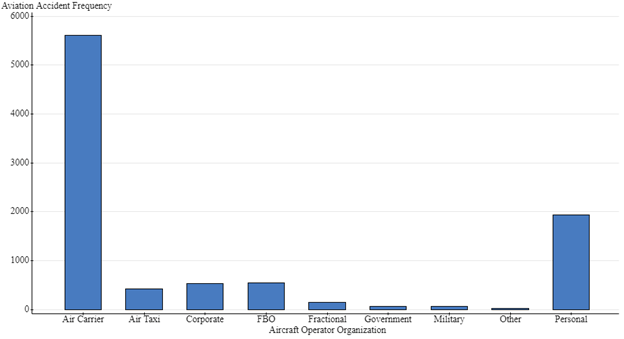
According to Table 2 and Chart 2 outlined in the Appendix, it has also been found that the aircraft operator organization with the most aviation accidents primarily caused by human factors over this five-year period are Air Carriers with 5,603 total cases and personal aircraft with 1,934 total cases. The organization with the least amount of aviation accidents primarily caused by human factors includes the Military and Government with both organizations staying below 20 cases per year.
Conclusions
With the overall determination that human factors do not account for 80% of aviation accidents as the FAA had claimed, the importance of transparency in the aviation industry was heavily outlined, especially when investigating and reporting accidents. To better understand the results of this study, further investigation was conducted regarding the high rate of aviation accidents within air carriers and in the state of California. A contributing factor and major limiting aspect of this study is the classification differences between human factors and non-human factors. Not only do these differences greatly affect the rate and type of accident reporting, but so has the fact that the ASRS is a voluntary self-reporting database which has resulted in several missing variables and factors within the given dataset. Thus, it can be deduced that the high aviation accident rate in California and by air carriers may be attributed to this leeway in classifications, a lack of understanding, and variances in reporting. It should also be noted that the state of California has been found to have the most registered general aviation aircrafts of any state with single-engine planes being the highest number, followed by multi-engine and jet engines while the busiest general aviation airports in California seeing over 487,000 operations in 2018 alone (“California Aviation Accidents: Who’s Liable in a Plane Crash Lawsuit,” n.d.). This can also explain both the high accident rates in California and amongst air carriers. If anything, this study has shown that there are several other factors, including ones outside of the aviation industry, that contributes more to the rate of aviation accident than previously thought.
With this, is it suggested that further investigation be conducted regarding the high rate of accidents in the State of California and lack of reporting in the aircraft organizations. Due to an expected increase in airspace activity, it is also suggested that standardization and the understanding of human factors be continually enforced, as well as more definitive investigative strategies and mandatory reporting measures. This is for better clarity and transparency within aviation when analyzing accidents and referring to human factors. These efforts will, hopefully, lead towards increased efficiency and overall safety in aviation and flight.
References
ASRS (2020). ASRS database online. Retrieved from https://asrs.arc.nasa.gov/search/database.html
California Aviation Accidents: Who’s Liable in a Plane Crash Lawsuit? (n.d.). Retrieved October 06, 2020, from https://www.enjuris.com/california/car-accident/aviation-accident.html
FAA Order 9550.8.A (1993). Retrieved from https://www.faa.gov/documentlibrary/media/order/9550.8.pdf
Low, J. M., & Yang, K. K. (2018). An exploratory study on the effects of human, technical and operating factors on aviation safety. Journal of Transportation Safety & Security, 11(6), 595-628. doi:10.1080/19439962.2018.1458051
Nitzschner, M. M., & Stein, M. (2019). Evaluating Psychological Aircraft Accident Reports for Differences in the Investigation of Human Factors. Human Performance Technology, 1302-1318. doi:10.4018/978-1-5225-8356-1.ch063
Role of Human Factors in the FAA. (2014, December). Retrieved October 4, 2020, from https://www.hf.faa.gov/media/RoleOfHF-FAA.pdf
Wilson Kehoe Winingham. (2020). Aviation Accidents: Human Error. Retrieved from https://www.wkw.com/aviation-accidents/blog/aviation-accidents-human-error/
Appendices
Figure 1
Chi-Square goodness-of-fit results for testing the 80% claim:
Observed: HF Issues
Expected: Expected HF Issues
| N | DF | Chi-Square | P-value |
| 9938 | 4 | 22.517908 | 0.0002 |
| Date | Observed Aviation Accidents Primarily Caused by Human Factors | Expected 80% Claim |
| 2015 | 2218 | 4750.4 |
| 2016 | 1908 | 4313.6 |
| 2017 | 1775 | 4165.6 |
| 2018 | 1991 | 4504.8 |
| 2019 | 2046 | 5040 |
Figure 2
Frequency of Aviation Accidents from 2015 – 2019
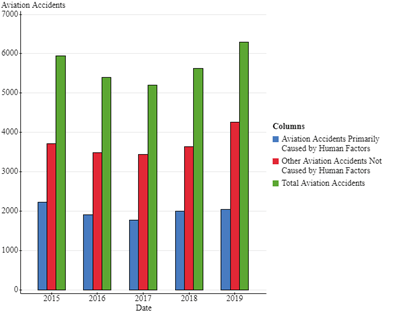
Figure 3
Regression of Aviation Accidents Primarily Caused by Human Factors from 2015 – 2019
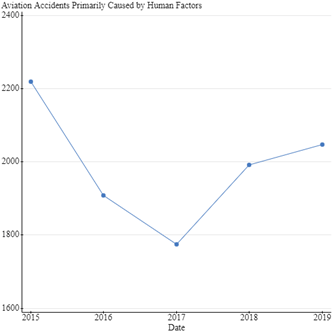
Table 1
Frequency of Human Factors Aviation Accidents per State from 2015 to 2019
| 50 U.S.A. States | Accident Frequency in 2015 | Accident Frequency in 2016 | Accident Frequency in 2017 | Accident Frequency in 2018 | Accident Frequency in 2019 | Total Frequency of Aviation Accidents Primarily Caused by Human Factors |
| AK | 13 | 14 | 16 | 16 | 5 | 64 |
| AL | 3 | 6 | 5 | 4 | 4 | 22 |
| AR | 3 | 2 | 3 | 1 | 4 | 13 |
| AZ | 46 | 33 | 33 | 22 | 28 | 162 |
| CA | 214 | 197 | 189 | 174 | 141 | 915 |
| CO | 58 | 45 | 47 | 93 | 62 | 305 |
| CT | 4 | 4 | 2 | 1 | 2 | 13 |
| DE | 1 | 1 | 2 | |||
| FL | 80 | 49 | 55 | 62 | 65 | 311 |
| GA | 40 | 29 | 33 | 31 | 22 | 155 |
| HI | 10 | 7 | 7 | 8 | 11 | 43 |
| IA | 7 | 2 | 4 | 7 | 4 | 24 |
| ID | 9 | 4 | 5 | 9 | 10 | 37 |
| IL | 64 | 50 | 44 | 60 | 39 | 257 |
| IN | 25 | 24 | 10 | 13 | 9 | 81 |
| KS | 9 | 10 | 5 | 7 | 4 | 35 |
| KY | 7 | 5 | 6 | 10 | 5 | 33 |
| LA | 6 | 8 | 5 | 8 | 3 | 30 |
| MA | 21 | 9 | 17 | 9 | 9 | 65 |
| MD | 18 | 20 | 8 | 9 | 11 | 66 |
| ME | 2 | 3 | 3 | 2 | 10 | |
| MI | 23 | 9 | 6 | 28 | 8 | 74 |
| MN | 17 | 10 | 21 | 14 | 19 | 81 |
| MO | 11 | 6 | 7 | 9 | 3 | 36 |
| MS | 4 | 1 | 1 | 1 | 7 | |
| MT | 3 | 1 | 1 | 5 | 7 | 17 |
| NC | 35 | 19 | 28 | 22 | 26 | 130 |
| ND | 3 | 5 | 1 | 6 | 3 | 18 |
| NE | 2 | 4 | 2 | 3 | 2 | 13 |
| NH | 8 | 4 | 2 | 14 | 9 | 37 |
| NJ | 33 | 18 | 20 | 22 | 19 | 112 |
| NM | 11 | 17 | 4 | 8 | 18 | 58 |
| NV | 29 | 25 | 20 | 16 | 10 | 100 |
| NY | 78 | 56 | 62 | 47 | 53 | 296 |
| OH | 19 | 16 | 8 | 21 | 13 | 77 |
| OK | 14 | 5 | 3 | 5 | 3 | 30 |
| OR | 26 | 16 | 18 | 14 | 7 | 81 |
| PA | 29 | 21 | 27 | 23 | 23 | 123 |
| RI | 4 | 1 | 1 | 2 | 4 | 12 |
| SC | 7 | 5 | 6 | 5 | 6 | 29 |
| SD | 2 | 4 | 3 | 2 | 11 | |
| TN | 21 | 13 | 17 | 23 | 11 | 85 |
| TX | 129 | 80 | 63 | 84 | 65 | 421 |
| UT | 18 | 20 | 12 | 18 | 21 | 89 |
| VA | 43 | 31 | 23 | 26 | 28 | 151 |
| VT | 4 | 1 | 3 | 1 | 1 | 10 |
| WA | 41 | 29 | 21 | 28 | 36 | 155 |
| WI | 14 | 9 | 11 | 6 | 14 | 54 |
| WV | 4 | 2 | 3 | 4 | 1 | 14 |
| WY | 3 | 3 | 2 | 3 | 1 | 12 |
Chart 1
Frequency of Aviation Accidents Primarily Caused by Human Factors from 2015 – 2019 by State
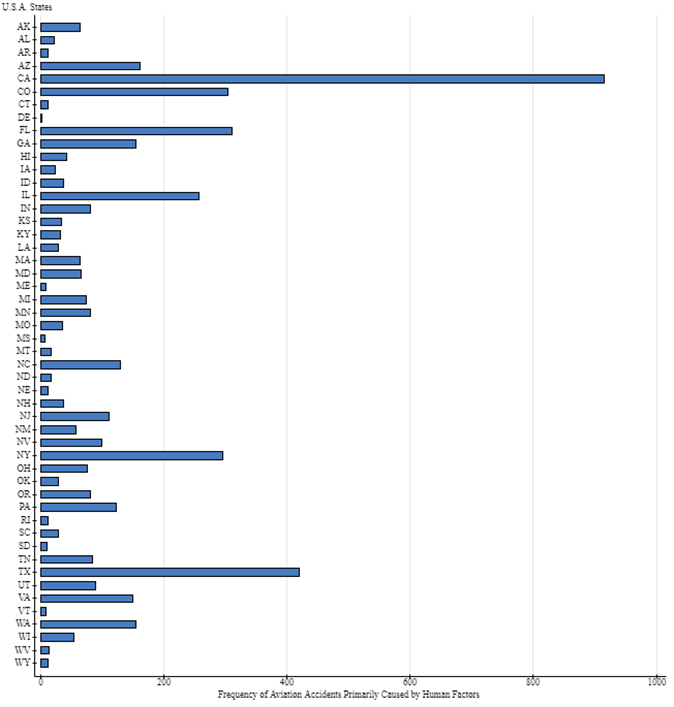
Table 2
Frequency of Human Factors Aviation Accidents per Aircraft Organization from 2015 to 2019
| Aircraft Operator Organization | Accident Frequency in 2015 | Accident Frequency in 2016 | Accident Frequency in 2017 | Accident Frequency in 2018 | Accident Frequency in 2019 | Total Accident Frequency |
| Air Carrier | 1338 | 1027 | 929 | 1121 | 1188 | 5603 |
| Air Taxi | 90 | 106 | 75 | 82 | 68 | 421 |
| Corporate | 138 | 112 | 104 | 85 | 92 | 531 |
| FBO | 101 | 129 | 118 | 100 | 98 | 546 |
| Fractional | 55 | 22 | 26 | 20 | 28 | 151 |
| Government | 14 | 14 | 6 | 16 | 8 | 58 |
| Military | 15 | 14 | 9 | 10 | 18 | 66 |
| Other | 7 | 4 | 16 | 27 | ||
| Personal | 365 | 387 | 403 | 372 | 407 | 1934 |
Chart 2
Frequency of Aviation Accidents Primarily Caused by Human Factors from 2015 – 2019 by Aircraft Organization
Originally created by Samantha Colangelo to fulfill requirements for Embry Riddle Aeronautical University’s Master of Science program in Human Factors. August, 2020.
 Samantha Colangelo